
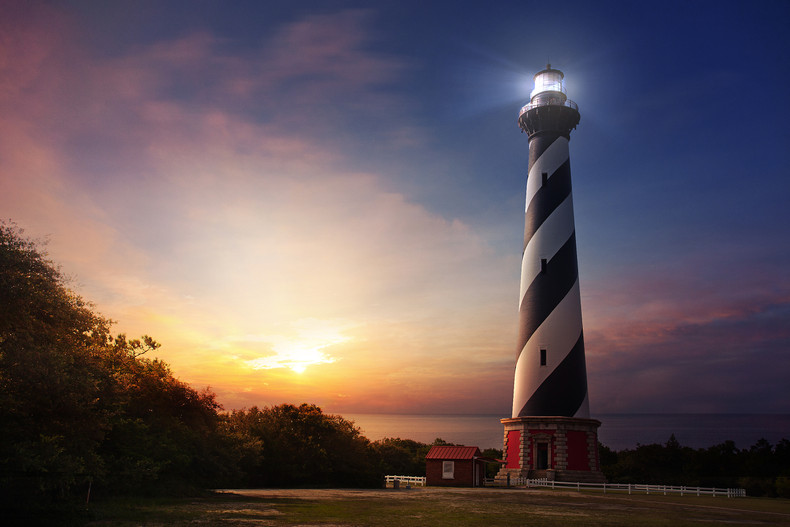
Few structures along America’s coastline capture the imagination quite like the Cape Hatteras Lighthouse. Rising in bold black-and-white spirals above North Carolina’s Outer Banks, it is more than a navigational aid—it is a testament to resilience, engineering ingenuity, and the enduring relationship between people and the sea.
A Coastline of Peril
Long before the lighthouse existed, the waters off Cape Hatteras were notorious among sailors. This stretch of the Atlantic earned the ominous nickname “Graveyard of the Atlantic,” where shifting shoals and converging currents from the Gulf Stream and Labrador Current created treacherous conditions. Hundreds—perhaps thousands—of ships met their end here. By the late 18th century, the young United States recognized the urgent need for a guiding light along this dangerous corridor.
The First Beacon
In 1803, the first Cape Hatteras Lighthouse was completed. Built of sandstone and standing about 90 feet tall, it was modest compared to today’s structure. Its light, fueled by whale oil, was relatively dim and often criticized for being difficult to see in poor weather. Mariners continued to struggle navigating the area, and it became clear that a more powerful beacon was needed.
Rebuilding for a Growing Nation
By the mid-19th century, increased coastal trade and naval activity pushed the government to act. In 1870, the current lighthouse was completed, replacing the original. Towering at 210 feet, it became—and remains—the tallest brick lighthouse in the United States. Its distinctive spiral daymark pattern of black and white bands was added not for decoration, but for visibility during daylight hours, helping sailors identify their position even before nightfall.
Inside, a first-order Fresnel lens magnified the light into a powerful beam visible for miles. This technological advancement dramatically improved maritime safety and marked a new era in lighthouse design.
War, Weather, and Wear
The lighthouse has stood through extraordinary challenges. During the Civil War, Confederate forces briefly dismantled the lens to prevent its use by Union ships. After the war, it was restored and returned to service. Over the decades, hurricanes battered the Outer Banks, testing the tower’s strength but never toppling it.
Yet the greatest threat came not from storms, but from the slow, relentless encroachment of the sea. The sandy barrier islands of the Outer Banks are constantly shifting, and by the late 20th century, erosion had brought the shoreline dangerously close—within a few dozen feet of the lighthouse.
The Great Move
In 1999, in one of the most ambitious preservation efforts in U.S. history, the entire lighthouse was relocated. Engineers carefully lifted the 4,830-ton structure and moved it 2,900 feet inland over the course of 23 days. The operation required precision, patience, and innovation, but it was a success. The lighthouse was safely repositioned on more stable ground, ensuring its survival for generations to come.
A Living Symbol
Today, the Cape Hatteras Lighthouse continues to shine as both a working navigational aid and a beloved historical landmark. Visitors climb its 257 steps not just for the panoramic views of the Atlantic, but to connect with a deeper story—one of danger, adaptation, and perseverance.
Its black-and-white spiral stands as a visual metaphor: a constant turning through time, guiding those who pass by. In a world where technology increasingly replaces tradition, the lighthouse remains a powerful reminder that sometimes, the simplest purpose—to light the way—can carry the greatest legacy.
