
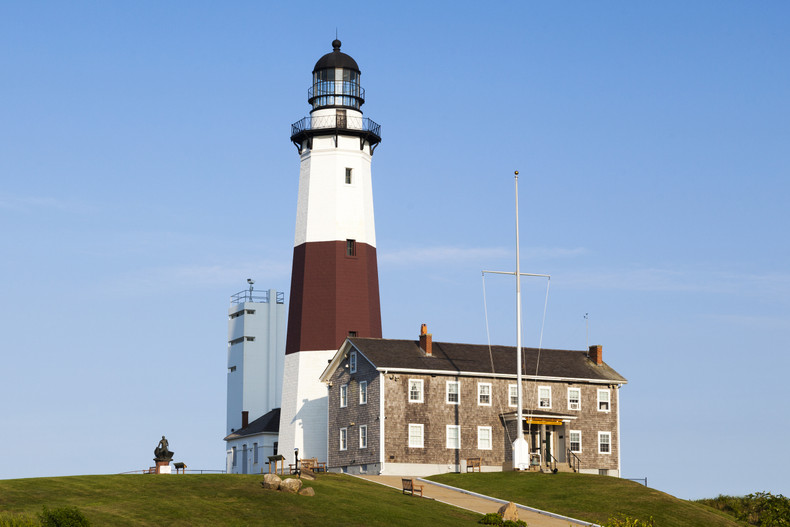
At the far eastern tip of Long Island, where the Atlantic Ocean stretches endlessly and the wind carries the scent of salt and history, stands the Montauk Lighthouse—America’s oldest lighthouse in New York State. More than just a scenic landmark, it is a symbol of the nation’s earliest efforts to protect its shores and guide its mariners safely home.
A Vision from the Beginning
The story of the Montauk Lighthouse begins with none other than President George Washington. In 1792, recognizing the strategic importance of New York’s coastline for trade and defense, Washington authorized the construction of a lighthouse at Montauk Point. At the time, the United States was still a young nation, and safeguarding its maritime routes was essential to its survival and growth.
Construction began shortly thereafter, and by 1796, the lighthouse was completed. Built from sandstone quarried in Connecticut, the tower rose 110 feet above the rocky shoreline. Its light—initially powered by whale oil—quickly became a critical navigational aid for ships traveling between New York Harbor and the open Atlantic.
Lighting the Early Republic
In its early years, the Montauk Lighthouse represented cutting-edge technology. Though modest by today’s standards, its fixed white light was visible for miles and helped reduce shipwrecks along the rugged coast. The first keeper, Ezekiel Sanford, took on the demanding task of maintaining the flame, trimming wicks, and ensuring the light never failed.
Life as a lighthouse keeper was far from easy. Isolated and exposed to harsh weather, keepers and their families endured long winters, violent storms, and the constant responsibility of keeping the light burning. Yet their dedication was vital—every night, lives depended on their vigilance.
Evolving with Innovation
As the 19th century progressed, so did lighthouse technology. In 1857, the Montauk Lighthouse was upgraded with a fourth-order Fresnel lens, dramatically increasing the brightness and efficiency of its beam. This innovation allowed the light to reach farther out to sea, offering greater सुरक्षा to passing vessels.
Other improvements followed, including stronger fuels like kerosene and structural reinforcements to withstand the coastal elements. Despite these upgrades, the lighthouse retained its original character—a testament to the durability of its initial design.
Enduring War and Change
Throughout its history, the Montauk Lighthouse has witnessed moments of national significance. During the War of 1812, British forces reportedly observed the lighthouse as they patrolled nearby waters. In World War II, the surrounding area became part of the United States’ coastal defense system, with military installations nearby guarding against potential enemy submarines.
Even as modern navigation technologies like GPS emerged, the lighthouse continued to serve as a reliable backup and a comforting visual guide for mariners.
A Fight Against the Sea
Like many coastal structures, the Montauk Lighthouse has faced the persistent threat of erosion. The powerful Atlantic waves gradually wore away the cliffs beneath it, bringing the edge dangerously close to the tower. By the late 20th century, concerns grew that the lighthouse might one day collapse into the sea.
In response, extensive preservation efforts were launched. In the 1990s, a major project reinforced the shoreline with boulders and other protective measures, stabilizing the bluff and securing the lighthouse’s future. Unlike some historic structures, Montauk’s beacon remained in its original location—steadfast against both time and tide.
A Beacon for Generations
Today, the Montauk Lighthouse is more than a navigational aid—it is a cherished historic site and a symbol of endurance. Visitors from around the world climb its spiral staircase, stand at its base, and gaze out over the vast Atlantic, imagining the countless sailors who once relied on its guiding light.
It represents the spirit of a young nation, the evolution of technology, and the unyielding human desire to explore and connect. Through wars, storms, and centuries of change, the Montauk Lighthouse has never stopped shining.
And perhaps that is its greatest legacy—not just that the lighthouse was built to guide ships, but that it continues to guide our understanding of history, resilience, and the enduring bond between land and sea.
